When Did Chef Pontiac Lead a Rebllion Agains the Britis
| Pontiac'due south War | |||||||||
|---|---|---|---|---|---|---|---|---|---|
| Part of the American Indian Wars | |||||||||
 In a famous council on April 27, 1763, Pontiac urged listeners to rise up against the British (19th century engraving by Alfred Bobbett) | |||||||||
| |||||||||
| Belligerents | |||||||||
 British Empire British Empire | Native Americans | ||||||||
| Commanders and leaders | |||||||||
| Jeffrey Amherst Henry Bouquet Thomas Gage | Pontiac Guyasuta | ||||||||
| Strength | |||||||||
| ~3,000 soldiers[one] [two] | ~3,500 warriors[2] | ||||||||
| Casualties and losses | |||||||||
| ~450 soldiers killed[three] ~450 civilians killed[4] ~four,000 civilians displaced[5] | 200+ warriors killed[6] civilian casualties unknown | ||||||||
Pontiac's State of war (besides known every bit Pontiac's Conspiracy or Pontiac's Rebellion) was launched in 1763 past a loose confederation of Native Americans dissatisfied with British rule in the Bully Lakes region following the French and Indian War (1754–1763). Warriors from numerous nations joined in an effort to drive British soldiers and settlers out of the region. The state of war is named after Odawa leader Pontiac, the most prominent of many Indigenous leaders in the conflict.
The war began in May 1763 when Native Americans, alarmed by policies imposed by British General Jeffrey Amherst, attacked a number of British forts and settlements. Viii forts were destroyed, and hundreds of colonists were killed or captured, with many more fleeing the region. Hostilities came to an stop after British Ground forces expeditions in 1764 led to peace negotiations over the next ii years. The Natives were unable to drive abroad the British, merely the uprising prompted the British government to modify the policies that had provoked the conflict.
Warfare on the North American frontier was brutal, and the killing of prisoners, the targeting of civilians, and other atrocities were widespread.[7] In an incident that became well-known and oftentimes debated, British officers at Fort Pitt attempted to infect besieging Indians with blankets that had been exposed to smallpox.[8] The ruthlessness of the conflict was a reflection of a growing racial carve up between Indigenous peoples and British colonists.[9] The British regime sought to foreclose farther racial violence past issuing the Regal Proclamation of 1763, which created a boundary betwixt colonists and Natives.[10]
Naming the war [edit]
The conflict is named after its most well-known participant, the Odawa leader named Pontiac. An early on proper name for the war was the "Kiyasuta and Pontiac State of war," "Kiaysuta" being an alternate spelling for Guyasuta, an influential Seneca/Mingo leader.[11] [12] The war became widely known as "Pontiac'southward Conspiracy" after the 1851 publication of Francis Parkman'southward The Conspiracy of Pontiac.[13] Parkman'south volume was the definitive account of the war for nearly a century and is still in print.[fourteen] [fifteen]
In the 20th century, some historians argued that Parkman exaggerated the extent of Pontiac's influence in the conflict, and then it was misleading to name the war later on him.[sixteen] Francis Jennings (1988) wrote that "Pontiac was only a local Ottawa war principal in a 'resistance' involving many tribes."[17] Alternate titles for the war have been proposed, such equally "Pontiac'southward War for Indian Independence,"[18] the "Western Indians' Defensive War"[19] and "The Amerindian State of war of 1763."[20] Historians by and large go on to use "Pontiac's War" or "Pontiac's Rebellion," with some 21st century scholars arguing that 20th century historians had underestimated Pontiac's importance.[21] [22]
Origins [edit]
You lot think yourselves Masters of this Land, because you lot have taken information technology from the French, who, you lot know, had no Right to information technology, as information technology is the Property of u.s.a. Indians.
Nimwha, Shawnee diplomat, to George Croghan, 1768[23]
In the decades before Pontiac's War, French republic and Great Britain participated in a series of wars in Europe that involved the French and Indian Wars in Due north America. The largest of these wars was the worldwide Seven Years' War, in which French republic lost New France in North America to Nifty Britain. Well-nigh fighting in the North American theater of the war, mostly called the French and Indian War in the United States, or the State of war of Conquest (French: Guerre de la Conquête) in French Canada, came to an end after British Full general Jeffrey Amherst captured French Montréal in 1760.[24]
British troops occupied forts in the Ohio Country and Great Lakes region previously garrisoned by the French. Fifty-fifty earlier the war officially ended with the Treaty of Paris (1763), the British Crown began to implement policy changes to administer its vastly expanded American territory. The French had long cultivated alliances amid Indigenous polities, but the British post-war approach substantially treated the Indigenous nations as conquered peoples.[25] Before long, Native Americans found themselves dissatisfied with the British occupation.
Tribes involved [edit]

The main area of action in Pontiac's Rebellion
Indigenous people involved in Pontiac's War lived in a vaguely divers region of New France known as the pays d'en haut ("the upper country"), which was claimed past France until the Paris peace treaty of 1763. Natives of the pays d'en haut were from many unlike tribal nations. These tribes were linguistic or ethnic groupings of anarchic communities rather than centralized political powers; no individual chief spoke for an entire tribe, and no nations acted in unison. For example, Ottawas did non go to war as a tribe: Some Ottawa leaders chose to practice then, while other Ottawa leaders denounced the state of war and stayed articulate of the conflict.[26]
The tribes of the pays d'en haut consisted of three basic groups. The first group was equanimous of tribes of the Great Lakes region: Ottawas, Ojibwes, and Potawatomis, who spoke Algonquian languages, and Hurons, who spoke an Iroquoian language. They had long been allied with French habitants with whom they lived, traded, and intermarried. Bang-up Lakes Indians were alarmed to larn they were nether British sovereignty later on the French loss of Due north America. When a British garrison took possession of Fort Detroit from the French in 1760, local Indians cautioned them that "this state was given past God to the Indians."[27] When the commencement Englishman reached Fort Michilimackinac, Ojibwe chief Minavavana told him "Englishman, although yous have conquered the French, yous have non still conquered us!"[28]
The second grouping was made up of tribes from eastern Illinois Country, which included Miamis, Weas, Kickapoos, Mascoutens, and Piankashaws.[29] Similar the Great Lakes tribes, these people had a long history of close relations with the French. Throughout the state of war, the British were unable to projection military power into the Illinois State, which was on the remote western edge of the disharmonize. The Illinois tribes were the last to come to terms with the British.[30]
The third group consisted of tribes of the Ohio Land: Delawares (Lenape), Shawnees, Wyandots, and Mingos. These people had migrated to the Ohio valley earlier in the century to escape British, French, and Iroquois domination.[31] Dissimilar the Cracking Lakes and Illinois Country tribes, Ohio tribes had no great attachment to the French authorities, though they had fought as French allies in the previous war in an attempt to drive abroad the British.[32] They made a separate peace with the British with the understanding that the British Ground forces would withdraw. But after the departure of the French, the British strengthened their forts rather than abandoning them, and so the Ohioans went to state of war in 1763 in some other effort to drive out the British.[33]
Exterior the pays d'en haut, the influential Iroquois did not, equally a group, participate in Pontiac's War because of their alliance with the British, known as the Covenant Chain. However, the westernmost Iroquois nation, the Seneca tribe, had go disaffected with the alliance. Every bit early as 1761, Senecas began to send out war messages to the Great Lakes and Ohio Land tribes, urging them to unite in an attempt to bulldoze out the British. When the war finally came in 1763, many Senecas were quick to accept activity.[34] [35]
Amherst'due south policies [edit]
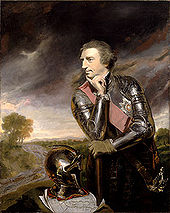
The policies of General Jeffrey Amherst, a British hero of the Seven Years' War, helped to provoke Pontiac's War (oil painting past Joshua Reynolds, 1765).
General Jeffrey Amherst, the British commander-in-primary in North America, was in accuse of administering policy towards American Indians, which involved armed forces matters and regulation of the fur trade. Amherst believed with France out of the motion picture, the Indians would have to take British rule. He too believed they were incapable of offer any serious resistance to the British Army, and therefore, of the 8,000 troops nether his command in North America, but almost 500 were stationed in the region where the war erupted.[36] Amherst and officers such as Major Henry Gladwin, commander at Fort Detroit, fabricated piddling try to conceal their contempt for Indians; those involved in the insurgence frequently complained that the British treated them no better than slaves or dogs.[37]
Additional Indian resentment came from Amherst's conclusion in February 1761 to cut dorsum on gifts given to the Indians. Gift giving had been an integral part of the relationship between the French and the tribes of the pays d'en haut. Following an Indian custom that carried important symbolic significant, the French gave presents (such as guns, knives, tobacco, and clothing) to village chiefs, who distributed them to their people. The chiefs gained stature this fashion, enabling them to maintain the alliance with the French.[38] The Indians regarded this equally "a necessary part of diplomacy which involved accepting gifts in return for others sharing their lands."[39] Amherst considered this to be bribery that was no longer necessary, especially as he was nether pressure level to cut expenses after the state of war. Many Indians regarded this change in policy equally an insult and an indication the British looked upon them as conquered people rather than as allies.[40] [41] [42]
Amherst as well began to restrict the amount of ammunition and gunpowder that traders could sell to Indians. While the French had always made these supplies available, Amherst did not trust Indians, particularly after the "Cherokee Rebellion" of 1761, in which Cherokee warriors took up arms against their former British allies. The Cherokee state of war endeavour had failed due to a shortage of gunpowder; Amherst hoped future uprisings could be prevented by limiting its distribution.[43] [44] This created resentment and hardship because gunpowder and ammunition helped Indians provide nutrient for their families and skins for the fur trade. Many Indians believed the British were convincing them as a prelude to war. Sir William Johnson, the Superintendent of the Indian Department, warned Amherst of the danger of cutting dorsum on presents and gunpowder, to no avail.[45] [46]
Land and organized religion [edit]
Land was also an issue in the coming of Pontiac'due south War. While the French colonists had ever been relatively few, there seemed to be no terminate of settlers in the British colonies. Shawnees and Delawares in the Ohio Country had been displaced by British colonists in the east, and this motivated their interest in the war. Indians in the Great Lakes region and the Illinois Country had not been greatly affected by white settlement, although they were aware of the experiences of tribes in the east. Dowd (2002) argues that most Indians involved in Pontiac's War were not immediately threatened with displacement by white settlers, and that historians have overemphasized British colonial expansion as a cause of the war. Dowd believes that the presence, attitude, and policies of the British Regular army, which the Indians establish threatening and insulting, were more of import factors.[47]
Also contributing to the outbreak of war was a religious awakening which swept through Indian settlements in the early 1760s. The movement was fed by discontent with the British too every bit nutrient shortages and epidemic affliction. The most influential individual in this miracle was Neolin, known equally the "Delaware Prophet," who called upon Indians to shun the merchandise goods, alcohol, and weapons of the colonists. Melding Christian doctrines with traditional Indian beliefs, Neolin said the Primary of Life was displeased with Indians for taking upward the bad habits of white men, and that the British posed a threat to their very existence. "If you suffer the English language among you," said Neolin, "you are dead men. Sickness, smallpox, and their poison [booze] will destroy you entirely."[48] It was a powerful bulletin for a people whose world was being changed by forces that seemed beyond their control.[49]
Outbreak of war, 1763 [edit]
Planning the state of war [edit]

Pontiac has ofttimes been imagined by artists, equally in this 19th-century painting past John Mix Stanley, but no actual portraits are known to be.[l]
Although fighting in Pontiac's War began in 1763, rumors reached British officials as early as 1761 that discontented American Indians were planning an attack. Senecas of the Ohio Country (Mingos) circulated messages ("war belts" fabricated of wampum) calling for the tribes to form a confederacy and drive away the British. The Mingos, led past Guyasuta and Tahaiadoris, were concerned well-nigh existence surrounded by British forts.[51] [52] [53] Similar war belts originated from Detroit and the Illinois Country.[54] The Indians were not unified, and in June 1761, natives at Detroit informed the British commander of the Seneca plot.[55] [56] William Johnson held a big council with the tribes at Detroit in September 1761, which provided a tenuous peace, but war belts connected to broadcast.[57] [58] Violence finally erupted after the Indians learned in early 1763 of the imminent French cession of the pays d'en haut to the British.[59]
The war began at Fort Detroit under the leadership of Pontiac and quickly spread throughout the region. 8 British forts were taken; others, including Fort Detroit and Fort Pitt, were unsuccessfully besieged. Francis Parkman's The Conspiracy of Pontiac portrayed these attacks every bit a coordinated operation planned by Pontiac.[19] [60] Parkman's interpretation remains well known, but later historians argued there is no clear evidence the attacks were part of a primary plan or overall "conspiracy."[61] [annotation i] Rather than existence planned in accelerate, modern scholars believe the insurgence spread equally word of Pontiac's actions at Detroit traveled throughout the pays d'en haut, inspiring discontented Indians to join the revolt. The attacks on British forts were not simultaneous: most Ohio Indians did non enter the war until nigh a month after Pontiac began the siege at Detroit.[19]
Early historians believed French colonists had secretly instigated the war by stirring up the Indians to make trouble for the British.[55] [63] This belief was held past British officials at the time, but subsequent historians establish no show of official French involvement in the insurgence.[64] [note two] According to Dowd (2002), "Indians sought French intervention and not the other style around."[66] Indian leaders frequently spoke of the imminent return of French power and the revival of the Franco-Indian brotherhood; Pontiac even flew a French flag in his village.[67] Indian leaders plainly hoped to inspire the French to rejoin the struggle against the British. Although some French colonists and traders supported the uprising, the war was launched by American Indians for their ain objectives.[68]
Middleton (2007) argues that Pontiac'southward vision, courage, persistence, and organizational abilities allowed him to actuate an unprecedented coalition of Indian nations prepared to fight against the British. Tahaiadoris and Guyasuta originated the idea to gain independence for all Indians west of the Allegheny Mountains, although Pontiac appeared to encompass the idea by February 1763. At an emergency council coming together, he clarified his military support of the broad Seneca program and worked to galvanize other tribes into the military operation he helped to lead, in directly contradiction to traditional Indian leadership and tribal construction. He achieved this coordination through the distribution of war belts, start to the northern Ojibwa and Ottawa most Michilimackinac, and then to the Mingo (Seneca) on the upper Allegheny River, the Ohio Delaware almost Fort Pitt, and the more westerly Miami, Kickapoo, Piankashaw, and Wea peoples.[69]
Siege of Fort Detroit [edit]
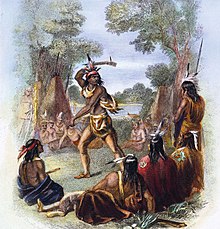
Pontiac takes up the state of war hatchet
Pontiac spoke at a quango on the banks of the Ecorse River on April 27, 1763, near 10 miles (15 km) southwest of Detroit. Using the teachings of Neolin to inspire his listeners, Pontiac convinced a number of Ottawas, Ojibwas, Potawatomis, and Hurons to join him in an endeavour to seize Fort Detroit.[70] On May 1, he visited the fort with l Ottawas to assess the strength of the garrison.[71] [72] According to a French chronicler, in a 2d council Pontiac proclaimed:
It is important for us, my brothers, that we exterminate from our lands this nation which seeks only to destroy us. You come across likewise as I that we can no longer supply our needs, every bit we have done from our brothers, the French.... Therefore, my brothers, we must all swear their destruction and await no longer. Nothing prevents us; they are few in numbers, and we tin can attain it.[73] [74]
On May 7, Pontiac entered Fort Detroit with near 300 men carrying curtained weapons, hoping to take the stronghold by surprise. The British had learned of his plan, however, and were armed and ready.[75] [note 3] His strategy foiled, Pontiac withdrew after a brief council and, two days later, laid siege to the fort. He and his allies killed British soldiers and settlers they establish exterior of the fort, including women and children.[77] They ritually cannibalized ane of the soldiers, equally was the custom in some Great Lakes Indian cultures.[78] They directed their violence at the British and generally left French colonists alone. Eventually more than 900 warriors from a half-dozen tribes joined the siege.[79]
After receiving reinforcements, the British attempted to brand a surprise assault on Pontiac's encampment. Pontiac was set and defeated them at the Battle of Bloody Run on July 31, 1763. The situation remained a stalemate at Fort Detroit, and Pontiac's influence amidst his followers began to wane. Groups of Indians began to carelessness the siege, some of them making peace with the British before departing. Pontiac lifted the siege on October 31, 1763, convinced that the French would not come to his assist at Detroit, and removed to the Maumee River where he connected his efforts to rally resistance confronting the British.[80]
Pocket-size forts taken [edit]

Forts and battles of Pontiac'southward War
Before other British outposts had learned of Pontiac's siege at Detroit, Indians captured five pocket-size forts in attacks betwixt May 16 and June two.[81] Fort Sandusky, a pocket-size blockhouse on the Lake Erie shore, was the start to exist taken. It had been built in 1761 by order of General Amherst, despite the objections of local Wyandots who warned the commander they would fire it down.[82] [83] On May 16, 1763, a group of Wyandots gained entry under the pretense of holding a quango, the same stratagem that had failed in Detroit nine days earlier. They seized the commander and killed 15 soldiers and a number of British traders,[84] [85] amidst the first of near 100 traders who were killed in the early on stages of the war.[81] They ritually scalped the dead and burned the fort to the basis, as the Wyandots had threatened a year earlier.[84] [86]
Potawatomis captured Fort St. Joseph (site of nowadays Niles, Michigan) on May 25, 1763, using the same method as at Sandusky. They seized the commander and killed most of the fifteen-human being garrison.[87] Fort Miami (present Fort Wayne, Indiana) was the third fort to fall. On May 27, the fort commander was lured out past his Indian mistress and shot dead past Miamis. The 9-human garrison surrendered after the fort was surrounded.[88]
In the Illinois Country, Weas, Kickapoos, and Mascoutens took Fort Ouiatenon, about 5 miles (viii.0 km) west of present Lafayette, Indiana, on June i, 1763. They lured soldiers outside for a quango, so took the 20-man garrison captive without mortality. These Indians had skillful relations with the British garrison, merely emissaries from Pontiac had convinced them to strike. The warriors apologized to the commander for taking the fort, proverb "they were Obliged to do it past the other Nations."[89] In contrast with other forts, the Indians did not kill their captives at Ouiatenon.[ninety]
The fifth fort to fall, Fort Michilimackinac (nowadays Mackinaw City, Michigan), was the largest fort taken by surprise. On June iv, 1763, Ojibwas staged a game of stickball with visiting Sauks. The soldiers watched the game, equally they had done on previous occasions. The Indians striking the brawl through the open gate of the fort, then rushed in and seized weapons that Indian women had smuggled into the fort. They killed well-nigh xv of the 35-homo garrison in the struggle; they later tortured five more to death.[91] [92] [93]
Three forts in the Ohio State were taken in a 2d wave of attacks in mid-June. Senecas took Fort Venango (near present Franklin, Pennsylvania) around June xvi, 1763. They killed the entire 12-man garrison, keeping the commander alive to write downwards the Seneca's grievances, then burned him at the stake.[94] Possibly the same Senecas attacked Fort Le Boeuf (present Waterford, Pennsylvania) on June 18, but about of the 12-man garrison escaped to Fort Pitt.[95]
The eighth and final fort to fall, Fort Presque Island (present Erie, Pennsylvania), was surrounded by about 250 Ottawas, Ojibwas, Wyandots, and Senecas on June xix. Later on belongings out for ii days, the garrison of thirty to lx men surrendered on the condition that they could return to Fort Pitt.[96] [97] The Indians agreed, but then took the soldiers captive, killing many.[98] [99]
Siege of Fort Pitt [edit]
Colonists in western Pennsylvania fled to the safety of Fort Pitt after the outbreak of the war. Nearly 550 people crowded inside, including more than 200 women and children.[100] [101] Simeon Ecuyer, the Swiss-born British officer in control, wrote that "Nosotros are so crowded in the fort that I fear affliction… the smallpox is among us."[100] Delawares and others attacked the fort on June 22, 1763, and kept it nether siege throughout July. Meanwhile, Delaware and Shawnee war parties raided into Pennsylvania, taking captives and killing unknown numbers of settlers. Indians sporadically fired on Fort Bedford and Fort Ligonier, smaller strongholds linking Fort Pitt to the east, simply they never took them.[102] [103]
Before the state of war, Amherst had dismissed the possibility that Indians would offer any effective resistance to British rule, merely that summertime he found the armed forces situation becoming increasingly grim. He wrote the commander at Fort Detroit that captured enemy Indians should "immediately be put to death, their extirpation being the simply security for our time to come safety."[104] To Colonel Henry Bouquet, who was preparing to lead an expedition to relieve Fort Pitt, Amherst wrote on about June 29, 1763: "Could information technology not be contrived to send the modest pox amid the disaffected tribes of Indians? We must on this occasion apply every stratagem in our power to reduce them."[104] [105] Bouquet responded that he would effort to spread smallpox to the Indians by giving them blankets that had been exposed to the affliction.[106] [note iv] Amherst replied to Boutonniere on July 16, endorsing the plan.[108] [109] [110] [notation 5]
As it turned out, officers at Fort Pitt had already attempted what Amherst and Bouquet were discussing, apparently without having been ordered by Amherst or Boutonniere.[111] [112] [note 6] During a parley at Fort Pitt on June 24, Captain Ecuyer gave representatives of the besieging Delawares two blankets and a handkerchief that had been exposed to smallpox, hoping to spread the disease to the Indians and terminate the siege.[114] [115] William Trent, the fort's militia commander, wrote in his periodical that "we gave them two Blankets and an Handkerchief out of the Small Pox Hospital. I promise it will have the desired result."[116] [117] Trent submitted an invoice to the British Ground forces, writing that the items had been "taken from people in the Infirmary to Convey the Smallpox to the Indians."[116] [117] The expense was approved by Ecuyer, and ultimately past General Thomas Gage, Amherst'due south successor.[117] [118]
Historian and folklorist Adrienne Mayor (1995) wrote that the smallpox blanket incident "has taken on legendary overtones as believers and nonbelievers continue to debate over the facts and their interpretation."[119] Peckham (1947), Jennings (1988), and Nester (2000) concluded the try to deliberately infect Indians with smallpox was successful, resulting in numerous deaths that hampered the Indian war effort.[120] [121] [122] Fenn (2000) argued that "coexisting evidence" suggests the attempt was successful.[8]
Other scholars have expressed doubts about whether the attempt was effective. McConnell (1992) argued the smallpox outbreak among the Indians preceded the coating incident, with limited effect, since Indians were familiar with the disease and good at isolating the infected.[123] Ranlet (2000) wrote that previous historians had overlooked that the Delaware chiefs who handled the blankets were in proficient wellness a month later; he believed the endeavour to infect the Indians had been a "total failure."[124] [note 7] Dixon (2005) argued that if the scheme had been successful, the Indians would have broken off the siege of Fort Pitt, but they kept information technology up for weeks after receiving the blankets.[126] Medical writers have expressed reservations about the efficacy of spreading smallpox through blankets and the difficulty of determining if the outbreak was intentional or naturally occurring.[127] [128] [note 8]
Bushy Run and Devil'due south Hole [edit]
On August 1, 1763, nearly of the Indians broke off the siege at Fort Pitt to intercept 500 British troops marching to the fort under Colonel Bouquet. On August five, these 2 forces met at the Battle of Bushy Run. Although his force suffered heavy casualties, Bouquet fought off the attack and relieved Fort Pitt on August xx, bringing the siege to an end. His victory at Bushy Run was celebrated by the British; church bells rang through the dark in Philadelphia, and King George praised him.[130]
This victory was followed past a costly defeat. Fort Niagara, one of the well-nigh important western forts, was not assaulted, but on September 14, 1763, at to the lowest degree 300 Senecas, Ottawas, and Ojibwas attacked a supply railroad train along the Niagara Falls portage. Two companies sent from Fort Niagara to rescue the supply train were also defeated. More than than lxx soldiers and teamsters were killed in these deportment, which colonists dubbed the "Devil'south Hole Massacre," the deadliest engagement for British soldiers during the war.[131] [132] [133]
Paxton Boys [edit]
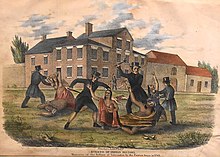
Massacre of the Indians at Lancaster past the Paxton Boys in 1763, lithograph published in Events in Indian History (John Wimer, 1841)
The violence and terror of Pontiac'south War convinced many western Pennsylvanians that their regime was not doing enough to protect them. This discontentment was manifested virtually seriously in an uprising led by a vigilante group known every bit the Paxton Boys, and then-chosen considering they were primarily from the area effectually the Pennsylvania village of Paxton (or Paxtang). The Paxtonians turned their acrimony towards American Indians—many of them Christians—who lived peacefully in small enclaves in the midst of white Pennsylvania settlements. Prompted by rumors that an Indian war political party had been seen at the Indian village of Conestoga, on December xiv, 1763, a grouping of more fifty Paxton Boys marched on the village and murdered the six Susquehannocks they establish there. Pennsylvania officials placed the remaining 14 Susquehannocks in protective custody in Lancaster, but on December 27, the Paxton Boys bankrupt into the jail and killed them. Governor John Penn issued bounties for the arrest of the murderers, but no one came forrad to place them.[134]
The Paxton Boys and so set their sights on other Indians living inside eastern Pennsylvania, many of whom fled to Philadelphia for protection. Several hundred Paxtonians marched on Philadelphia in January 1764, where the presence of British troops and Philadelphia militia prevented them from committing more violence. Benjamin Franklin, who had helped organize the militia, negotiated with the Paxton leaders and brought an finish to the crisis. Afterwards, Franklin published a scathing indictment of the Paxton Boys. "If an Indian injures me," he asked, "does it follow that I may revenge that Injury on all Indians?"[135]
British response, 1764–1766 [edit]
Indian raids on frontier settlements escalated in the leap and summer of 1764. The hardest hit colony was Virginia, where more than 100 settlers were killed.[136] On May 26 in Maryland, xv colonists working in a field nearly Fort Cumberland were killed. On June fourteen, about xiii settlers near Fort Loudoun in Pennsylvania were killed and their homes burned. The well-nigh notorious raid occurred on July 26, when four Delaware warriors killed and scalped a school instructor and ten children in what is at present Franklin County, Pennsylvania. Incidents such every bit these prompted the Pennsylvania Assembly, with the approval of Governor Penn, to reintroduce the scalp bounties offered during the French and Indian War, which paid coin for every enemy Indian killed above the age of 10, including women.[136] [137]
General Amherst, held responsible for the uprising past the Board of Merchandise, was recalled to London in Baronial 1763 and replaced by Major General Thomas Gage. In 1764, Gage sent 2 expeditions into the west to beat the rebellion, rescue British prisoners, and arrest the Indians responsible for the war. According to historian Fred Anderson, Gage's campaign, which had been designed past Amherst, prolonged the war for more than a year because it focused on punishing the Indians rather than catastrophe the war. Cuff's ane significant departure from Amherst's plan was to allow William Johnson to comport a peace treaty at Niagara, giving Indians an opportunity to "coffin the hatchet."[138]
Fort Niagara treaty [edit]
From July to August 1764, Johnson conducted a treaty at Fort Niagara with about two,000 Indians in attendance, primarily Iroquois. Although nearly Iroquois had stayed out of the war, Senecas from the Genesee River valley had taken upwards arms confronting the British, and Johnson worked to bring them back into the Covenant Concatenation alliance. As restitution for the Devil'due south Hole ambush, the Senecas were compelled to sacrifice the strategically important Niagara portage to the British. Johnson even convinced the Iroquois to send a war party against the Ohio Indians. This Iroquois expedition captured a number of Delawares and destroyed abandoned Delaware and Shawnee towns in the Susquehanna Valley, but otherwise the Iroquois did non contribute to the war endeavor every bit much as Johnson had desired.[139] [140] [141]
Two expeditions [edit]
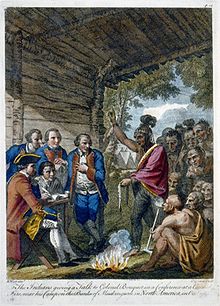
Bouquet'southward negotiations are depicted in this 1765 engraving based on a painting by Benjamin West. The Indian orator holds a chugalug of wampum, essential for diplomacy in the Eastern Woodlands.
Having secured the area around Fort Niagara, the British launched two military machine expeditions into the west. The first expedition, led by Colonel John Bradstreet, was to travel by boat across Lake Erie and reinforce Detroit. Bradstreet was to subdue the Indians around Detroit before marching south into the Ohio Country. The second expedition, commanded by Colonel Bouquet, was to march west from Fort Pitt and class a second front in the Ohio Land.
Bradstreet left Fort Schlosser in early Baronial 1764 with about 1,200 soldiers and a large contingent of Indian allies enlisted past Sir William Johnson. Bradstreet felt that he did non take plenty troops to subdue enemy Indians by strength, and and so when strong winds on Lake Erie forced him to stop at Fort Presque Island on Baronial 12, he decided to negotiate a treaty with a delegation of Ohio Indians led by Guyasuta. Bradstreet exceeded his authorization by conducting a peace treaty rather than a simple truce, and past agreeing to halt Bouquet'due south trek, which had not even so left Fort Pitt. Gage, Johnson, and Bouquet were outraged when they learned what Bradstreet had done. Gage rejected the treaty, assertive that Bradstreet had been duped into abandoning his offensive in the Ohio Country. Gage may have been correct: the Ohio Indians did non return prisoners as promised in a second meeting with Bradstreet in September, and some Shawnees were trying to enlist French assist in social club to continue the state of war.[142] [143] [144] [145]
Bradstreet continued w, unaware his unauthorized diplomacy was angering his superiors. He reached Fort Detroit on August 26, where he negotiated another treaty. In an attempt to discredit Pontiac, who was not nowadays, Bradstreet chopped upward a peace belt Pontiac had sent to the meeting. According to historian Richard White, "such an human activity, roughly equivalent to a European ambassador's urinating on a proposed treaty, had shocked and offended the gathered Indians." Bradstreet also claimed the Indians had accepted British sovereignty as a outcome of his negotiations, merely Johnson believed this had not been fully explained to the Indians and that farther councils would exist needed. Bradstreet had successfully reinforced and reoccupied British forts in the region, merely his diplomacy proved to exist controversial and inconclusive.[146] [147] [148]
Colonel Bouquet, delayed in Pennsylvania while mustering the militia, finally set out from Fort Pitt on October iii, 1764, with 1,150 men. He marched to the Muskingum River in the Ohio Country, within striking altitude of a number of Indian villages. Treaties had been negotiated at Fort Niagara and Fort Detroit, so the Ohio Indians were isolated and, with some exceptions, ready to make peace. In a quango which began on October 17, Boutonniere demanded that the Ohio Indians return all captives, including those not nonetheless returned from the French and Indian War. Guyasuta and other leaders reluctantly handed over more than 200 captives, many of whom had been adopted into Indian families. Not all of the captives were present, so the Indians were compelled to give up hostages every bit a guarantee that the other captives would be returned. The Ohio Indians agreed to attend a more than formal peace conference with William Johnson, which was finalized in July 1765.[149] [150] [151]
Treaty with Pontiac [edit]
Although the military conflict essentially ended with the 1764 expeditions,[152] Indians all the same called for resistance in the Illinois Land, where British troops had yet to take possession of Fort de Chartres from the French. A Shawnee war chief named Charlot Kaské emerged as the most strident anti-British leader in the region, temporarily surpassing Pontiac in influence. Kaské traveled as far s as New Orleans in an try to enlist French aid confronting the British.[153] [154] [155]
In 1765, the British decided that the occupation of the Illinois Land could only exist accomplished by diplomatic ways. As Gage commented to one of his officers, he was determined to have "none our enemy" among the Indian peoples, and that included Pontiac, to whom he now sent a wampum belt suggesting peace talks. Pontiac had become less militant subsequently hearing of Boutonniere'south truce with the Ohio country Indians.[156] [157] Johnson'southward deputy, George Croghan, accordingly traveled to the Illinois country in the summertime of 1765, and although he was injured along the manner in an attack past Kickapoos and Mascoutens, he managed to meet and negotiate with Pontiac. While Charlot Kaské wanted to fire Croghan at the stake,[158] Pontiac urged moderation and agreed to travel to New York, where he fabricated a formal treaty with William Johnson at Fort Ontario on July 25, 1766. Information technology was hardly a surrender: no lands were ceded, no prisoners returned, and no hostages were taken.[159] Rather than accept British sovereignty, Kaské left British territory by crossing the Mississippi River with other French and Native refugees.[160]
Aftermath [edit]
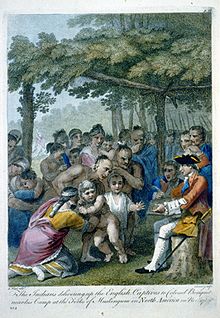
Because many children taken as captives had been adopted into Native families, their forced return often resulted in emotional scenes, as depicted in this engraving based on a painting past Benjamin Due west.
The total loss of life resulting from Pontiac's War is unknown. About 400 British soldiers were killed in action and perhaps 50 were captured and tortured to death.[3] [161] George Croghan estimated that 2,000 settlers had been killed or captured,[162] a figure sometimes repeated as 2,000 settlers killed.[163] [164] [annotation 9] [note ten] The violence compelled approximately four,000 settlers from Pennsylvania and Virginia to flee their homes.[five] American Indian losses went mostly unrecorded, but it has been estimated at to the lowest degree 200 warriors were killed in battle,[six] with additional deaths if germ warfare initiated at Fort Pitt was successful.[4] [165]
Pontiac's War has traditionally been portrayed as a defeat for the Indians,[166] only scholars at present ordinarily view it every bit a military stalemate: while the Indians had failed to bulldoze away the British, the British were unable to conquer the Indians. Negotiation and adaptation, rather than success on the battlefield, ultimately brought an end to the state of war.[167] [168] [169] The Indians had won a victory of sorts past compelling the British regime to abandon Amherst's policies and create a human relationship with the Indians modeled on the Franco-Indian brotherhood.[170] [171] [172]
Relations between British colonists and American Indians, which had been severely strained during the French and Indian War, reached a new low during Pontiac'southward State of war.[173] According to Dixon (2005), "Pontiac's State of war was unprecedented for its awful violence, every bit both sides seemed intoxicated with genocidal fanaticism."[7] Richter (2001) characterizes the Indian endeavor to drive out the British, and the effort of the Paxton Boys to eliminate Indians from their midst, every bit parallel examples of indigenous cleansing.[174] People on both sides of the disharmonize had come to the conclusion that colonists and natives were inherently dissimilar and could non alive with each other. According to Richter, the war saw the emergence of "the novel idea that all Native people were 'Indians,' that all Euro-Americans were 'Whites,' and that all on i side must unite to destroy the other."[9]
The British government also came to the decision that colonists and Indians must be kept apart. On October 7, 1763, the Crown issued the Royal Proclamation of 1763, an effort to reorganize British North America after the Treaty of Paris. The Proclamation, already in the works when Pontiac's War erupted, was hurriedly issued later news of the uprising reached London. Officials drew a boundary line betwixt the British colonies and American Indian lands west of the Appalachian Mountains, creating a vast "Indian Reserve" that stretched from the Appalachians to the Mississippi River and from Florida to Quebec. By forbidding colonists from trespassing on Indian lands, the British government hoped to avoid more conflicts similar Pontiac'southward War. "The Royal Proclamation," writes Calloway (2006), "reflected the notion that segregation non interaction should characterize Indian-white relations."[10]
The furnishings of Pontiac's War were long-lasting. Because the Proclamation officially recognized that indigenous people had certain rights to the lands they occupied, information technology has been called a Native American "Pecker of Rights," and still informs the human relationship between the Canadian government and First Nations.[175] For British colonists and land speculators, however, the Announcement seemed to deny them the fruits of victory—western lands—that had been won in the war with France. This created resentment, undermining colonial attachment to the Empire and contributing to the coming of the American Revolution.[176] According to Calloway, "Pontiac's Revolt was not the last American state of war for independence—American colonists launched a rather more successful effort a dozen years later, prompted in role by the measures the British regime took to try to prevent some other state of war like Pontiac's."[177]
For American Indians, Pontiac's State of war demonstrated the possibilities of pan-tribal cooperation in resisting Anglo-American colonial expansion. Although the conflict divided tribes and villages,[178] the state of war as well saw the first all-encompassing multi-tribal resistance to European colonization in North America,[179] and the first war between Europeans and American Indians that did not finish in complete defeat for the Indians.[180] The Annunciation of 1763 ultimately did non forestall British colonists and land speculators from expanding westward, and and then Indians found information technology necessary to form new resistance movements. Get-go with conferences hosted past Shawnees in 1767, in the following decades leaders such as Joseph Brant, Alexander McGillivray, Blueish Jacket, and Tecumseh would effort to forge confederacies that would revive the resistance efforts of Pontiac'due south War.[181] [182]
References [edit]
Notes [edit]
- ^ Jacobs supported Parkman's thesis that Pontiac planned the war in accelerate, but objected to calling it a "conspiracy" because it suggested Indian grievances were unjustified.[62]
- ^ The rumor of French instigation arose in office because French war belts from the Seven Years' War were still in circulation.[65]
- ^ Major Gladwin, the fort'due south commander, did non reveal who warned him of Pontiac's plan; historians identify several possibilities.[76]
- ^ Bouquet to Amherst, July xiii: "I will try to inoculate the bastards with some blankets that may fall into their hands, and have care not to get the affliction myself."[107]
- ^ Amherst to Bouquet, July 16: "You volition do well to inoculate the Indians past means of blankets, as well as every other method that can serve to extirpate this execrable race."[107]
- ^ "Neither Amherst nor Bouquet actually tried germ warfare. The attempt to disseminate smallpox took place at Fort Pitt independent of both of them."[113]
- ^ "Deliberately trying to spread disease is despicable in any century it might take place, but the smallpox incident has been blown out of all proportion, given that information technology was likely a total failure."[125]
- ^ "Even so, in the light of contemporary knowledge, it remains doubtful whether [Ecuyer'due south] hopes were fulfilled, given the fact that the transmission of smallpox through this kind of vector is much less efficient than respiratory transmission…."[129]
- ^ Nester subsequently revises this number down to about 450 settlers killed.[4]
- ^ Dowd argues that Croghan'south widely reported estimate "cannot be taken seriously" because it was a "wild gauge" made while Croghan was far abroad in London.[162]
Citations [edit]
- ^ Dixon 2005, p. 158.
- ^ a b Dowd 2002, p. 117.
- ^ a b Peckham 1947, p. 239.
- ^ a b c Nester 2000, p. 279.
- ^ a b Dowd 2002, p. 275.
- ^ a b Middleton 2007, p. 202.
- ^ a b Dixon 2005, p. xiii.
- ^ a b Fenn 2000, p. 1558.
- ^ a b Richter 2001, p. 208.
- ^ a b Calloway 2006, p. 92.
- ^ Dixon 2005, p. 303n21.
- ^ Peckham 1947, p. 107n.
- ^ Nester 2000, p. x.
- ^ McConnell 1994, p. xiii.
- ^ Dowd 2002, p. 7.
- ^ Middleton 2006, pp. 2–3.
- ^ Jennings 1988, p. 442.
- ^ Jacobs 1972, p. 93.
- ^ a b c McConnell 1992, p. 182.
- ^ Steele 1994, p. 235.
- ^ Dixon 2005, p. 131.
- ^ Middleton 2006, pp. 1–32.
- ^ Dowd 2002, p. 216.
- ^ Anderson 2000, p. 453.
- ^ White 1991, p. 256.
- ^ White 1991, pp. fourteen, 287.
- ^ White 1991, p. 260.
- ^ Skaggs 2001, p. ane.
- ^ Dowd 2002, p. 168.
- ^ Anderson 2000, pp. 626–32.
- ^ McConnell 1992, pp. 5–twenty.
- ^ White 1991, pp. 240–45.
- ^ White 1991, pp. 248–55.
- ^ Dixon 2005, pp. 85–89.
- ^ Middleton 2007, pp. 96–99.
- ^ Dixon 2005, pp. 157–58.
- ^ Dowd 2002, pp. 63–69.
- ^ White 1991, pp. 36, 113, 179–83.
- ^ Borrows 1997, p. 170.
- ^ White 1991, pp. 256–58.
- ^ McConnell 1992, pp. 163–64.
- ^ Dowd 2002, pp. 70–75.
- ^ Anderson 2000, pp. 468–71.
- ^ Dixon 2005, p. 78.
- ^ Dowd 2002, pp. 76–77.
- ^ Dixon 2005, p. 83.
- ^ Dowd 2002, pp. 82–83.
- ^ Dowd 1992, p. 34.
- ^ White 1991, pp. 279–85.
- ^ Dowd 2002, p. 6.
- ^ White 1991, p. 272.
- ^ Dixon 2005, pp. 85–87.
- ^ Middleton 2007, pp. 33–46.
- ^ White 1991, p. 276.
- ^ a b Dowd 2002, p. 105.
- ^ Dixon 2005, pp. 87–88.
- ^ Dixon 2005, pp. 92–93, 100.
- ^ Nester 2000, pp. 46–47.
- ^ Dixon 2005, p. 104.
- ^ Parkman 1870, pp. 1:186–87.
- ^ Peckham 1947, pp. 108–x.
- ^ Jacobs 1972, pp. 83–90.
- ^ Peckham 1947, p. 105.
- ^ Dowd 2002, pp. 105–13.
- ^ White 1991, pp. 276–77.
- ^ Dowd 2002, p. 121.
- ^ Dowd 2002, p. 160.
- ^ Calloway 2006, p. 126.
- ^ Middleton 2007, pp. 68–73.
- ^ Parkman 1870, pp. ane:200–08.
- ^ Dixon 2005, p. 108.
- ^ Peckham 1947, p. 116.
- ^ Peckham 1947, pp. 119–xx.
- ^ Dixon 2005, p. 109.
- ^ Nester 2000, pp. 77–78.
- ^ Dixon 2005, pp. 109–x.
- ^ Dixon 2005, pp. 111–12.
- ^ Dixon 2005, p. 114.
- ^ Anderson 2000, p. 538.
- ^ Dowd 2002, p. 139.
- ^ a b Dowd 2002, p. 125.
- ^ McConnell 1992, p. 167.
- ^ Nester 2000, p. 44.
- ^ a b Nester 2000, p. 86.
- ^ Dixon 2005, p. 119.
- ^ Parkman 1870, p. ane:271.
- ^ Nester 2000, pp. 88–89.
- ^ Nester 2000, p. 90.
- ^ Dixon 2005, p. 121.
- ^ Nester 2000, pp. xc–91.
- ^ Dixon 2005, p. 122.
- ^ Dowd 2002, p. 126.
- ^ Nester 2000, pp. 95–97.
- ^ Nester 2000, p. 99.
- ^ Nester 2000, pp. 101–02.
- ^ Dowd 2002, p. 127.
- ^ Dixon 2005, p. 149.
- ^ Dowd 2002, p. 128.
- ^ Middleton 2007, pp. 98–99.
- ^ a b Dixon 2005, p. 151.
- ^ Nester 2000, p. 92.
- ^ Dowd 2002, p. 130.
- ^ Nester 2000, p. 130.
- ^ a b Peckham 1947, p. 226.
- ^ Anderson 2000, pp. 542, 809n11.
- ^ Fenn 2000, pp. 1555–56.
- ^ a b Anderson 2000, p. 809n11.
- ^ Fenn 2000, pp. 1556–57.
- ^ Grenier 2005, pp. 144–45.
- ^ Nester 2000, pp. 114–fifteen.
- ^ Anderson 2000, p. 542.
- ^ Fenn 2000, p. 1557.
- ^ Ranlet 2000, p. 431.
- ^ Anderson 2000, p. 541.
- ^ Jennings 1988, p. 447n26.
- ^ a b Ranlet 2000, p. 428.
- ^ a b c Fenn 2000, p. 1554.
- ^ Ranlet 2000, p. 430.
- ^ Mayor 1995, p. 57.
- ^ Peckham 1947, p. 170.
- ^ Jennings 1988, pp. 447–48.
- ^ Nester 2000, p. 112.
- ^ McConnell 1992, pp. 195–96.
- ^ Ranlet 2000, pp. 434, 438.
- ^ Ranlet 2000, p. 438.
- ^ Dixon 2005, p. 154–55.
- ^ Dembek 2007, pp. 2–3.
- ^ Barras & Greub 2014.
- ^ Barras & Greub 2014, p. 499.
- ^ Dixon 2005, p. 196.
- ^ Peckham 1947, pp. 224–25.
- ^ Dixon 2005, p. 210–11.
- ^ Dowd 2002, p. 137.
- ^ Nester 2000, p. 173.
- ^ Nester 2000, p. 176.
- ^ a b Nester 2000, p. 194.
- ^ Dixon 2005, pp. 222–24.
- ^ Anderson 2000, pp. 553, 617–20.
- ^ McConnell 1992, pp. 197–99.
- ^ Dixon 2005, pp. 219–20, 228.
- ^ Dowd 2002, pp. 151–53.
- ^ White 1991, pp. 291–92.
- ^ McConnell 1992, pp. 199–200.
- ^ Dixon 2005, pp. 228–29.
- ^ Dowd 2002, pp. 155–58.
- ^ White 1991, pp. 297–98.
- ^ Dixon 2005, pp. 227–32.
- ^ Dowd 2002, pp. 153–62.
- ^ McConnell 1992, pp. 201–05.
- ^ Dixon 2005, pp. 233–41.
- ^ Dowd 2002, pp. 162–65.
- ^ Dixon 2005, p. 242.
- ^ White 1991, pp. 300–01.
- ^ Dowd 2002, pp. 217–19.
- ^ Middleton 2007, pp. 183–99.
- ^ Middleton 2007, p. 189.
- ^ White 1991, p. 302.
- ^ White 1991, p. 305n70.
- ^ Dowd 2002, pp. 253–54.
- ^ Calloway 2006, pp. 76, 150.
- ^ Nester 2000, p. 280.
- ^ a b Dowd 2002, p. 142.
- ^ Jennings 1988, p. 446.
- ^ Nester 2000, pp. 7, 172.
- ^ Fenn 2000, pp. 1557–58.
- ^ Peckham 1947, p. 322.
- ^ Dixon 2005, pp. 242–43.
- ^ White 1991, p. 289.
- ^ McConnell 1994, p. fifteen.
- ^ White 1991, pp. 305–09.
- ^ Calloway 2006, p. 76.
- ^ Richter 2001, p. 210.
- ^ Calloway 2006, p. 77.
- ^ Richter 2001, pp. 190–91.
- ^ Calloway 2006, pp. 96–98.
- ^ Dixon 2005, p. 246.
- ^ Calloway 2006, p. 91.
- ^ Hinderaker 1997, p. 156.
- ^ Steele 1994, p. 234.
- ^ Steele 1994, p. 247.
- ^ Dowd 1992, pp. 42–43, 91–93.
- ^ Dowd 2002, pp. 264–66.
Sources [edit]
- Anderson, Fred (2000). Crucible of War: The Vii Years' State of war and the Fate of Empire in British North America, 1754–1766. New York: Knopf. ISBN0-375-40642-5.
- Barras, V; Greub, G (2014). "History of biological warfare and bioterrorism". Clinical Microbiology and Infection. 20 (6): 497–502. doi:10.1111/1469-0691.12706. PMID 24894605.
- Borrows, John (1997). "Wampum at Niagara: The Imperial Proclamation, Canadian Legal History, and Cocky Government" (PDF). In Asch, Michael (ed.). Ancient and Treaty Rights in Canada: Essays on Law, Equity, and Respect for Difference. Vancouver: UBC Press. pp. 169–72. ISBN978-0-7748-0581-0.
- Calloway, Colin (2006). The Scratch of a Pen: 1763 and the Transformation of Due north America. New York: Oxford Academy Press. ISBN0-19-530071-8.
- Dembek, Zygmunt F., ed. (2007). Medical Aspects of Biological Warfare. Government Printing Role. ISBN978-0-16-087238-ix.
- Dixon, David (2005). Never Come to Peace Again: Pontiac's Uprising and the Fate of the British Empire in North America. Norman: University of Oklahoma Press. ISBN0-8061-3656-1.
- Dowd, Gregory Evans (1992). A Spirited Resistance: The North American Indian Struggle for Unity, 1745–1815. Baltimore: Johns Hopkins University Press. ISBN0-8018-4609-9.
- Dowd, Gregory Evans (2002). War nether Heaven: Pontiac, the Indian Nations, & the British Empire. Baltimore: Johns Hopkins Academy Press. ISBN0-8018-7079-8.
- Fenn, Elizabeth A. (2000). "Warfare in Eighteenth-Century Northward America: Across Jeffery Amherst". The Journal of American History. 86 (4): 1552–1580. doi:10.2307/2567577. JSTOR 2567577.
- Grenier, John (2005). The Starting time Fashion of State of war: American War Making on the Borderland, 1607–1814. Cambridge: Cambridge University Press. ISBN0-521-84566-one.
- Hinderaker, Eric (1997). Elusive Empires: Constructing Colonialism in the Ohio Valley, 1763–1800. Cambridge: Cambridge University Press. ISBN0-521-66345-viii.
- Jacobs, Wilbur R (1972). "Pontiac's State of war—A Conspiracy?". Dispossessing the American Indian: Indians and Whites on the Colonial Frontier. New York: Scribners. pp. 83–93. ISBN978-0806119359.
- Jennings, Francis (1988). Empire of Fortune: Crowns, Colonies, and Tribes in the 7 Years War in America' . New York: Norton. ISBN0-393-30640-ii.
- Mayor, Adrienne (1995). "The Nessus Shirt in the New World: Smallpox Blankets in History and Legend". The Journal of American Folklore. 108 (427): 54–77. doi:10.2307/541734. JSTOR 541734. Retrieved January 15, 2021.
- McConnell, Michael N. (1992). A Country Between: The Upper Ohio Valley and Its Peoples, 1724–1774. Lincoln: University of Nebraska Press. ISBN0-8032-8238-nine.
- McConnell, Michael Northward. (1994). "Introduction to the Bison Book Edition" of The Conspiracy of Pontiac past Francis Parkman . Lincoln: University of Nebraska Press. ISBN0-8032-8733-Ten.
- Middleton, Richard (2006). "Pontiac: Local Warrior or Pan Indian Leader?". Michigan Historical Review. 32 (2): 1–32. doi:10.1353/mhr.2006.0028.
- Middleton, Richard (2007). Pontiac's War: Its Causes, Course, and Consequences. New York: Routledge. ISBN978-0-415-97913-nine.
- Nester, William R. (2000). "Haughty Conquerors": Amherst and the Great Indian Uprising of 1763. Westport, Connecticut: Praeger. ISBN0-275-96770-0.
- Parkman, Francis (1870). The Conspiracy of Pontiac and the Indian War after the Conquest of Canada (1994 reprint of 10th revised ed.). Lincoln: University of Nebraska Press. ISBN0-8032-8733-X. Parkman's landmark 2-volume piece of work, originally published in 1851, later revised and often reprinted, has largely been supplanted past modernistic scholarship.
- Peckham, Howard H. (1947). Pontiac and the Indian Uprising. Chicago: University of Chicago Press. ISBN0-8143-2469-X.
- Ranlet, Philip (2000). "The British, the Indians, and Smallpox: What Actually Happened at Fort Pitt in 1763?". Pennsylvania History: A Journal of Mid-Atlantic Studies. 67 (iii): 427–441. JSTOR 27774278. Retrieved Jan 13, 2021.
- Richter, Daniel Thou. (2001). Facing Due east from Indian Land: A Native History of Early America. Cambridge, Massachusetts: Harvard University Printing. ISBN0-674-00638-0.
- Skaggs, David Curtis; Nelson, Larry 50., eds. (2001). The Sixty Years' War for the Great Lakes, 1754–1814. E Lansing: Michigan State University Press. ISBN0-87013-569-4.
- Steele, Ian K. (1994). Warpaths: Invasions of North America. New York: Oxford University Press. ISBN0-19-508223-0.
- White, Richard (1991). The Middle Ground: Indians, Empires, and Republics in the Great Lakes Region, 1650–1815. Cambridge: Cambridge University Press. ISBN0-521-42460-7.
Source: https://en.wikipedia.org/wiki/Pontiac%27s_War

Post a Comment for "When Did Chef Pontiac Lead a Rebllion Agains the Britis"